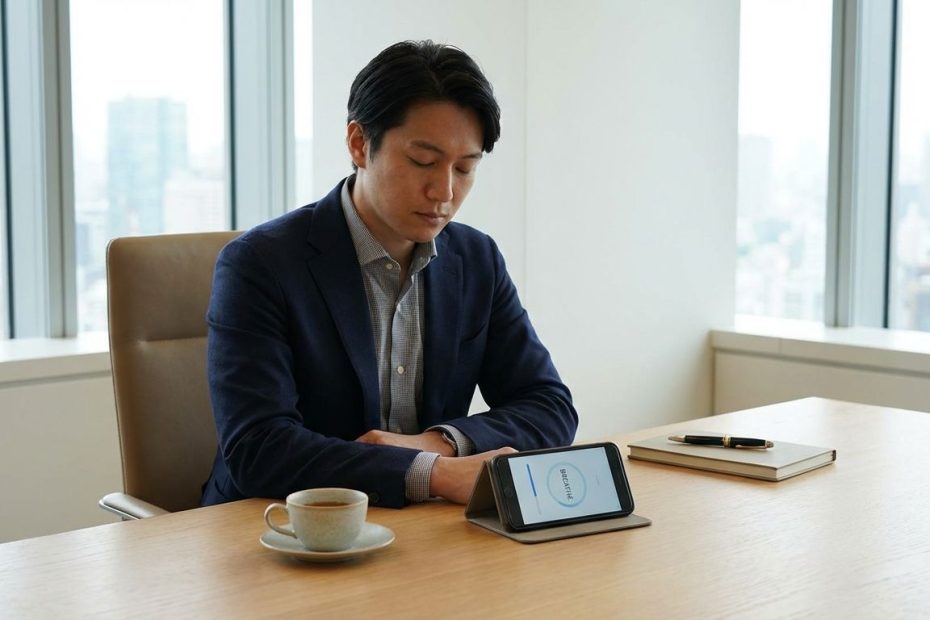
Mindfulness apps earn a real place in CEO stress management when you use them like a performance tool: short, consistent sessions that lower perceived stress, reduce rumination, and improve recovery between high-stakes decisions.
You do not need another productivity ritual that dies in week two. You need a low-friction method that fits board prep, earnings calls, travel, and inbox pressure, then holds up under measurement. This article shows where the evidence supports app-based mindfulness, what “minimum effective” usage looks like, how to choose an app for executive needs, what to measure, and how to avoid the common failure points that make these tools feel like hype.
Do Mindfulness Apps Actually Reduce CEO Stress, Or Is It Just Hype?
You are right to be skeptical, because “stress relief” is an overloaded claim. In practice, the question that matters is whether a short digital program can move validated stress measures, not whether it feels pleasant on a good day. The strongest signal comes from randomized trials where app-driven meditation reduces perceived stress with meaningful effect sizes, not tiny shifts that disappear when the study ends.
A large randomized clinical trial published by JAMA Network Open tested a digital meditation program in a working population and found significant reductions in perceived stress at eight weeks, plus improvements across several work-related outcomes. Participants were instructed to meditate 10 minutes per day for eight weeks, which maps to the time reality most executives can tolerate without negotiating their calendar every morning. When the data shows change at that dose, it supports a CEO use case: you can implement the habit without redesigning your life.
CEO stress is not identical to employee stress, yet the mechanism looks familiar: repetitive problem loops, constant vigilance, sleep fragmentation, and decision fatigue under uncertainty. When an intervention reduces perceived stress and supports recovery behaviors, it becomes useful even if it does not touch the external drivers. That distinction matters: mindfulness apps do not remove workload, they reduce the “carryover cost” your nervous system pays after every hard meeting.
Another advantage is speed of feedback. If a tool requires months before you notice anything, adherence drops fast in executive schedules. Evidence using ecological momentary assessment (stress checks throughout the day) shows app-based practice can reduce subjective stress and perseverative thinking early in the intervention window, which aligns with how leaders adopt habits: quick proof, then continued use.
Where the hype starts is when apps are presented as a substitute for operational fixes, leadership team design, or clinical care when needed. Stress that comes from chronic overload, persistent conflict, or untreated mental health conditions rarely resolves through a single tool. A mindfulness app works best as a stabilizer you can execute daily, not as the only lever you pull when the job is structurally unsustainable.
What’s The Minimum Effective Dose For A Busy CEO—5 Minutes Or 20 Minutes A Day?
If you are running a company, the “best” plan is the one that survives travel days, crisis days, and back-to-back days. The practical starting point is 5–10 minutes on most days, with a bias toward frequency over occasional long sessions. Your calendar does not need another appointment, it needs a repeatable micro-block you can protect even when everything else shifts.
The JAMA Network Open randomized trial instructed participants to complete 10 minutes per day for eight weeks and observed strong reductions in perceived stress at the eight-week mark. That matters because it anchors the habit to a dose that is realistic. It also reinforces a CEO truth: time is not the main barrier, consistency is. Ten minutes is rarely the problem; the problem is that ten minutes gets traded away the moment the day becomes unpredictable.
Real-world data from Headspace members points in the same direction. When people engage more frequently, stress reduction improves, and the signal is stronger for “active days” and “sessions” than raw minutes. That aligns with executive physiology and behavior: short resets repeated across a week keep arousal from stacking. A single long session cannot reliably undo six days of constant activation.
Use a two-tier dose that you can run without negotiation. Tier one is your default: 5 minutes on standard workdays, anchored to an existing cue (first coffee, first calendar check, or immediately after the last meeting). Tier two is your upgrade: 10–12 minutes on days with heavy decision density, travel, or sleep pressure. This gives you flexibility without breaking the habit loop.
If the app offers “streaks,” treat them as a compliance tool, not as a self-worth scorecard. Your operating standard is measured execution, not perfection. Missed days happen; the performance move is restarting within 24 hours, not waiting for a clean Monday.
Which Mindfulness Apps Are Most Useful For Executive Stress And Sleep—Headspace, Calm, Insight Timer, Balance?
The best app for an executive is not the one with the most content, it is the one that reduces friction and matches your stress profile. CEOs typically fall into a few patterns: cognitive overdrive and rumination, sleep disruption, nervous-system spikes before high-stakes moments, or chronic background tension that never fully drops. The app choice should map to that pattern, then lock into repeatable use.
Third-party reviews still cluster a familiar set of leaders—Calm, Headspace, Insight Timer, and others—because they cover the core modalities executives use: guided meditation, breath work, sleep content, and structured courses. Forbes Health’s 2026 review highlights major options and pricing characteristics, which is useful when you need a quick shortlist rather than a deep market scan. If you are choosing for personal use, the subscription cost matters less than whether the app becomes a daily behavior within two weeks.
Headspace tends to work well when you want structure. Leaders who dislike browsing and decision overload do better with programs that tell you what to do each day. Headspace also has a strong corporate-facing offering, which matters if you want a standardized tool you can extend across the executive team or broader organization without reinventing governance and reporting.
Calm often fits executives who are solving for sleep and downshifting. If your most expensive stress symptom is sleep latency, early waking, or difficulty turning the mind off after late calls, you will value an app with sleep-focused content you actually use at night. Leaders who travel also benefit from consistent audio routines that make new hotel rooms feel less “activating” to the nervous system.
Insight Timer and similar library-heavy apps work when you value breadth and cost control. They also appeal to leaders who already know what they like and do not need a structured course. The risk for many CEOs is choice overload: if the app makes you scroll for five minutes, you will quit. If you pick this style, save favorites and reduce decisions to one tap.
Personalization-first apps can be valuable when you want a guided plan without doing the planning. The practical question is whether the personalization reduces friction or adds it through onboarding and constant prompts. A CEO tool must execute fast: open, start, finish, move on.
Are Mindfulness Apps Being Used In Corporate Wellness Or EAP Programs, And What Do Employers Want To Measure?
Mindfulness apps are now common in employer benefit stacks, and that is not driven by trend-chasing. Employers want scalable support that employees can use without waiting weeks for an appointment. They also want reporting that shows utilization, engagement, and outcome movement, because leadership teams get pressed to justify spend and prove that well-being support is not decorative.
Headspace’s employer offering reflects what corporate buyers demand: access, programmability, and the ability to support employees and families at scale. For CEOs, this matters for two reasons. One, you can adopt the same tool personally that you offer your organization, which reduces the optics problem of “executive wellness” being separate. Two, you can use the same measurement language across the business, which improves credibility when you discuss mental fitness as a performance variable.
Measurement should stay tied to validated constructs and operational outcomes. The JAMA trial used perceived stress measures and reported improvements not only in stress but also in job strain and related outcomes at eight weeks. Real-world Headspace data used the PSS-10 and showed an average reduction over a short follow-up window, with stronger change linked to higher engagement frequency. When you talk about this inside a leadership team, that language lands: validated scale movement, dose-response patterns, and behavior-based compliance.
At the executive level, add a simple performance layer to the metrics. Track sleep duration and sleep consistency, meeting density days versus recovery days, and your self-rated decision quality at the end of heavy days. This is not about turning well-being into vanity metrics. It is about connecting a daily practice to your ability to stay calm in conflict, absorb uncertainty without spiraling, and make fewer reactive calls when pressure spikes.
If you are deploying apps across the organization, require clear reporting boundaries. Wellness reporting should be aggregated and privacy-protective, not a tool for monitoring individuals. The moment employees believe usage will be used against them, adoption collapses and leadership trust takes a measurable hit.
Why Are CEOs Turning To Mindfulness Tools Right Now—What’s Happening With Executive Stress In 2025–2026?
Executive stress is not hypothetical; it is being measured openly in business research and surveys. Sentry’s 2025 C-Suite Stress Index reports that 67% of surveyed executives said they were more stressed in 2025 than the prior year, based on a survey of 1,000 U.S. business leaders conducted from November 25 to December 9, 2024. When two-thirds of leadership reports rising stress, it stops being a personal weakness story and becomes an operating environment reality.
Vistage’s Q2 2025 CEO Confidence reporting adds another sharp data point: 68% of CEOs reported feeling burned out or emotionally exhausted at least occasionally over the prior three months, and a meaningful portion reported frequent burnout. Vistage also noted sleep and recharge constraints, which are exactly where mindfulness apps often create early wins. CEOs do not adopt these tools because they want a new hobby; they adopt them because the cost of unmanaged stress shows up in short temper, reduced patience, reactive messaging, and inconsistent decision quality.
The pattern in 2025–2026 is straightforward: uncertainty remains high, hiring and productivity demands remain intense, and the pace of operational decisions keeps climbing. Leaders are searching for tools that are private, fast to deploy, and usable without adding appointments to an already dense schedule. Mindfulness apps meet that bar when implemented with discipline, because they compress the time between “pressure hits” and “recovery begins.”
Use this moment to formalize mental fitness as part of executive operating standards. That does not mean turning leadership into a wellness program. It means treating stress reactivity like any other performance limiter: identify it, reduce it, and measure whether the intervention moves the needle.
Best Mindfulness App Routine For CEO Stress
- Daily: 5–10 minutes, same time, one saved session
- High-pressure days: add a 2-minute breathing reset pre-meeting
- Weekly: review usage days, sleep, and stress rating
Build A CEO-Caliber Practice That Holds Under Pressure
Mindfulness apps work for CEO stress when you treat them as a measurable daily control, not a vague self-care idea. The evidence supports meaningful reductions in perceived stress from brief digital programs, and real-world data shows engagement frequency links to better outcomes. The decision that matters is not which app is popular; it is whether the app reduces friction enough to become your default recovery action. Lock in a minimum daily dose, tie it to a clear objective like sleep or rumination control, and measure impact with a few simple indicators you trust. When you execute that plan for eight weeks, you give your nervous system fewer chances to run your calendar for you.
References
- JAMA Network Open: Digital Meditation to Target Employee Stress: A Randomized Clinical Trial. https://jamanetwork.com/journals/jamanetworkopen/fullarticle/2829186
- PubMed (Annals of Behavioral Medicine RCT listing): App-based mindfulness meditation reduces stress in novice meditators (Headspace) using ecological momentary assessment. https://pubmed.ncbi.nlm.nih.gov/40257119/
- JMIR mHealth and uHealth (2024): The Real-World Impact of App-Based Mindfulness on Headspace Members With Moderate and Severe Perceived Stress: Observational Study. https://mhealth.jmir.org/2024/1/e52968
- Forbes Health (2026): 10 Best Meditation Apps of 2026. https://www.forbes.com/health/mind/best-meditation-apps/
- Sentry (2025): 2025 C-Suite Stress Index Report. https://www.sentry.com/about-us/company-news-and-events/2025-csuite-stress-index
- PR Newswire (Feb 3, 2025): 67% of executives more stressed in 2025: Sentry survey finds. https://www.prnewswire.com/news-releases/67-of-executives-more-stressed-in-2025-sentry-survey-finds-302366073.html
- Vistage (July 2, 2025): CEO Confidence Continues to Cool in Q2 2025 as Hiring Plans Hit an All-Time Low. https://www.vistage.com/press-center/press-release/ceo-confidence-continues-to-cool-in-q2-2025-as-hiring-plans-hit-an-all-time-low/

Olivier Gillier is a global investment strategist and co-founder of RioBlanco Capital LLC, with over 20 years of experience in wealth management and international markets. A former Senior Vice President at Merrill Lynch, he now focuses on private equity, cross-border finance, and philanthropic initiatives worldwide.