
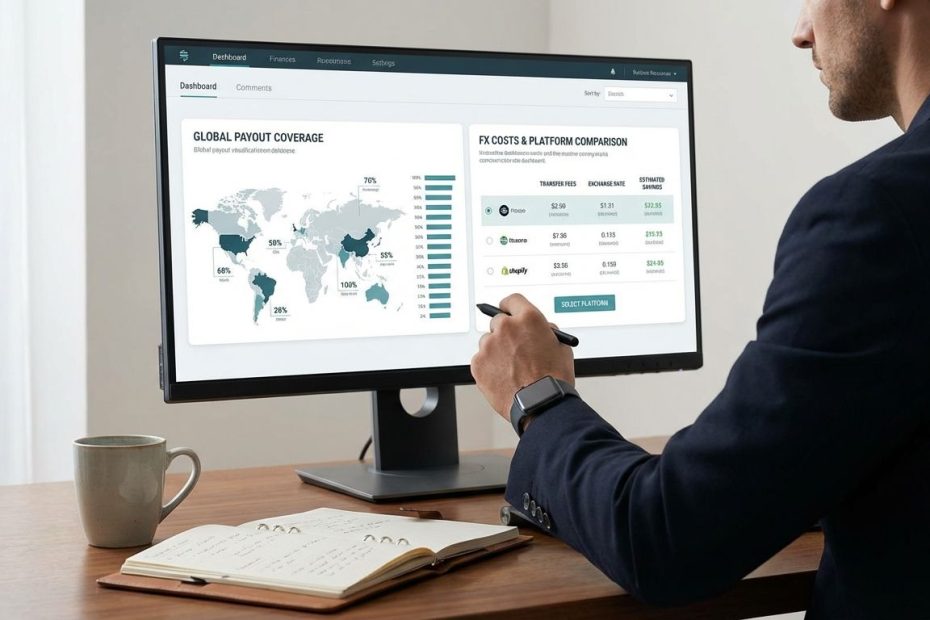
You get the biggest gains in global finance efficiency when cross-border payments stop behaving like one-off “projects” and start running like an optimized payments stack—fast settlement, predictable FX, clean reconciliation data, and compliance that scales. The seven platforms below earn their spot because they consistently reduce friction across speed, cost, payout coverage, integrations, and operational control.
This article gives you a buyer-ready view of the seven best cross-border payment platforms—what each one is best at, where it tends to fit in a real business, and what experienced operators measure (FX spread, failure rates, chargebacks, beneficiary experience, and reconciliation time). You’ll also get practical selection criteria tied to the standards and targets shaping the next wave of cross-border payments performance.
1. Wise Business
Wise Business is best when you need transparent FX pricing and simple international transfers that finance teams can reconcile quickly. It fits SMB to mid-market operators paying overseas vendors, contractors, and subsidiaries across common corridors.
Wise’s edge is cost predictability and day-to-day usability. You typically see fewer “mystery fees” because fees and FX costs are shown up front, and multi-currency account structures simplify holding and converting funds close to the time you actually need to pay. In practical terms, this reduces the habit of converting “too early” (locking in a rate that later looks bad) or “too late” (missing payroll or supplier deadlines).
Operationally, Wise Business usually lands well for teams that live in the accounting system and want clean proof of payment. Real finance efficiency shows up when reconciliation stops being a weekly fire drill: payer name consistency, reference fields that don’t get mangled, and fewer beneficiary bank detail errors. Many teams also value the ability to segregate funds by currency for budgeting and to reduce repeated conversions when you invoice or pay in the same currencies month after month.
A realistic use case is a US-based agency paying contractors in the UK and EU. When payments run on predictable rails and you can attach references that match invoices, the month-end close speeds up because exceptions fall. That is the efficiency win that compounds.
2. Airwallex
Airwallex is a strong pick when you need a more “platform-like” setup: multi-currency accounts, cards, and APIs that support global collections and payouts. It’s commonly used by ecommerce, SaaS, and marketplaces that want one operational layer for FX, treasury, and payouts.
Where Airwallex earns its keep is control. You can centralize currency exposure management, define payout workflows, and keep teams from improvising with ad hoc bank wires that create audit noise. Many operators use it to reduce dependency on local bank account openings in every market, while still collecting and paying in multiple currencies with a single finance ops playbook.
The efficiency story usually comes down to throughput and automation. If payout batches, approvals, and beneficiary management live inside one system (or sync tightly via API), finance operations stops being a spreadsheet relay race. This matters most when volumes rise: the same headcount handles more payouts without raising failure rates.
A concrete example is a marketplace paying sellers across APAC and Europe. When seller payouts run through consistent beneficiary validation and automated payout files, customer support tickets drop (“where’s my payout?”), and finance avoids manual tracing and bank investigation fees.
3. Payoneer
Payoneer is often chosen for mass payouts—freelancers, creators, cross-border suppliers, and marketplace sellers—where beneficiary convenience matters as much as back-office reporting. It fits businesses that pay a large, diverse base of recipients who may prefer local-like receipt options.
Payoneer tends to perform well when you cannot assume every recipient has the same banking sophistication or even the same preference for receiving funds. The operational win shows up when recipients can receive funds with less friction, because every payout exception costs real money: support time, reputational hit, and reprocessing fees.
From a finance efficiency standpoint, Payoneer commonly reduces payout fragmentation. Teams that previously used multiple regional tools (one for LATAM, one for parts of Asia, one for Europe) often consolidate. Consolidation alone doesn’t guarantee savings, yet it typically improves controls: fewer credentials to manage, consistent payout status tracking, and more standardized payout reporting.
A real-world pattern: an ecommerce operator sourcing from multiple countries pays hundreds of suppliers monthly. When the payout experience is consistent and status visibility is strong, supplier relationship management stabilizes—fewer shipment delays tied to payment disputes or missing confirmations.
4. Revolut Business
Revolut Business fits teams that want fast onboarding, multi-currency spend and transfers, and strong day-to-day control over employee spending. It’s commonly used by internationally distributed teams that need to pay vendors, run subscriptions, and manage travel or contractor expenses across borders.
The strength here is “operational tightness.” You can reduce leakage by issuing cards with limits, locking merchant categories, and mapping spend to cost centers. Cross-border efficiency isn’t only about wires; it’s also about keeping global spend disciplined so the finance team isn’t chasing receipts and explaining FX surprises after the fact.
Revolut can also help simplify how teams hold and convert currencies for planned expenses. Finance teams that run recurring payments in EUR or GBP often find it easier to manage conversions in a controlled way rather than letting every card transaction convert at the moment of purchase with inconsistent timing and documentation.
A practical use case: a US company with teams in London and Berlin runs global SaaS subscriptions and travel expenses. When spend is controlled and categorized at the point of purchase, month-end close time shrinks and management reporting becomes more reliable.
5. Stripe (Connect / Treasury / Global Payouts Capabilities)
Stripe is a top choice when payments are embedded in a product—platforms, marketplaces, SaaS billing, and global commerce—where cross-border collections, compliance workflows, and payout orchestration must be programmable. It is less about “sending a wire” and more about building a monetization engine that works internationally.
Stripe’s advantage is developer-grade integration and ecosystem depth. Many operators use Stripe Connect to manage onboarding, KYC/KYB workflows, payouts, and fee splits at scale, reducing manual compliance handling and payout file management. That’s global finance efficiency in a product-led sense: fewer operational touchpoints per transaction.
Efficiency also shows up in data. When payment events, disputes, refunds, and payout statuses are structured and accessible by API, you can build reconciliation that matches how your business actually runs. Teams that rely on manual exports often miss failure patterns until they get expensive; teams with event-driven reporting detect issues early and reduce exception volume.
A concrete example is a B2B SaaS platform paying referral partners internationally. If partner payouts can be automated from invoicing or usage data, and partners see predictable payout timing, the platform reduces support tickets and protects retention without expanding finance headcount.
6. Adyen
Adyen is typically selected by larger, global merchants that need high reliability, deep acquiring capabilities, and unified commerce across regions. It fits businesses where a small improvement in authorization rates, settlement predictability, or chargeback handling creates outsized financial impact.
For global efficiency, Adyen’s value often comes from performance at scale. When you run high volumes across multiple regions, operational cost is driven by exception handling—failed payments, reconciliation gaps, and dispute workflows. Strong acquiring and consistent reporting can reduce the hidden “cost per transaction” that doesn’t appear in a simple fee comparison.
Adyen is also used to standardize global operations: one payments partner, consistent risk tooling, and centralized reporting while still supporting local payment methods. That reduces internal complexity. Complexity is the silent killer of cross-border efficiency because it multiplies edge cases and creates operational fragmentation.
A real merchant pattern: an international retailer selling online in North America and Europe with local payment methods. When authorization rates hold steady and settlements reconcile cleanly, finance stops chasing pennies across multiple PSPs and banks.
7. SWIFT gpi (Via Bank Partners)
SWIFT gpi is not a “platform” in the fintech UI sense, yet it remains central to cross-border business payments through banks—especially for higher-value transfers where traceability and bank-grade compliance are non-negotiable. It fits corporates that need predictable processing, strong tracking, and global reach via existing banking relationships.
The efficiency gain with SWIFT gpi is visibility and speed improvements within the correspondent banking model. SWIFT has reported a large share of cross-border payments processed within an hour on its network, which helps reduce the operational drag of “payment tracing” and beneficiary uncertainty. That matters in treasury operations where time-sensitive supplier payments or settlement deadlines create downstream costs.
SWIFT rails are also being reshaped by the ISO 20022 migration, which improves payment data quality and interoperability. Better structured data reduces repair rates, screening friction, and reconciliation mismatches—three of the biggest cost drivers in cross-border operations. The industry is working toward key deadlines and adoption milestones, and teams that upgrade their payment data handling see fewer investigations and fewer “lost in translation” reference fields.
A practical example is a US importer paying manufacturers across multiple countries using bank wires. When payments carry richer structured data and tracking is reliable, vendor release cycles speed up and the finance team spends less time paying “investigation fees” to locate payments.
What Is The Best Cross-Border Payment Platform For A Business?
- Best overall fit: depends on volume + payout countries + integrations
- Low-cost FX + simple ops: Wise Business
- APIs + marketplaces: Stripe or Airwallex
- Enterprise commerce: Adyen
Build Your Shortlist, Then Measure What Matters
Global finance efficiency comes from measurable outcomes: lower total cost (fees + FX), faster crediting, fewer payout failures, cleaner reconciliation, and less time spent on investigations. Industry targets are pushing speed and cost expectations tighter over the next few years, and structured payment data standards are raising the bar for compliance-ready automation.
Run platform selection like an operator: map your top corridors, quantify exception rates, and score vendors on payout coverage, beneficiary experience, FX transparency, and integration depth. Then pressure-test with a pilot that tracks failure reasons and reconciliation time, not just headline pricing. If the platform makes payment status obvious, references consistent, and exceptions rare, the business gets faster closes, fewer support tickets, and more predictable cash positioning.

Olivier Gillier is a global investment strategist and co-founder of RioBlanco Capital LLC, with over 20 years of experience in wealth management and international markets. A former Senior Vice President at Merrill Lynch, he now focuses on private equity, cross-border finance, and philanthropic initiatives worldwide.