Modern mentorship works when you treat the relationship as a deliberate system, not a casual stream of messages. In a digital world, you mentor and get mentored well by setting clear goals, choosing the right communication channels, building trust through consistency, and documenting progress so the relationship keeps moving.
You no longer need to sit in the same office, city, or industry circle to grow through mentorship. You do need structure, boundaries, and better communication habits than most people bring to the table. This article shows you how to build a mentoring relationship that feels human, useful, and durable even when it runs through video calls, chat threads, and shared documents.
What Is Digital Mentorship, And How Is It Different From Traditional Mentoring?
Digital mentorship is a mentoring relationship that happens partly or fully through digital communication, including video calls, voice calls, email, messaging platforms, and shared workspaces. The purpose stays the same: you help someone grow, solve better problems, and make stronger career decisions, or you seek that kind of guidance from someone ahead of you. What changes is the operating model. You lose informal contact, visible body language, and spontaneous follow-up, so you need to replace those missing signals with clearer systems.
In a traditional office setting, a mentoring relationship can survive on proximity for a while. You run into each other, you ask a quick question after a meeting, you sense when the other person has time, and you pick up meaning from tone and timing. Online, those cues are weaker or absent. If you do not define cadence, communication rules, and goals, the relationship drifts fast, even when both people have good intentions.
This is why digital mentorship should never be treated as a weaker copy of in-person mentoring. It is a different format that rewards written clarity, predictable check-ins, and intentional follow-through. If you understand that early, you stop waiting for chemistry to carry the relationship and start building the habits that make it productive.
You also need to think in terms of channel design. Some conversations belong in live video because tone, complexity, or sensitivity matters. Some belong in asynchronous communication because reflection and convenience matter more. The best mentors and mentees do not default to one tool. They match the communication method to the purpose of the interaction.
How Do You Find A Mentor Online Without Sounding Transactional?
You find a mentor online by leading with a clear learning need, a focused ask, and a real reason for reaching out to that specific person. Most people fail here because they ask for “mentorship” before they have earned any trust. That word can feel vague, heavy, and demanding. A better move is to ask for a short conversation around one issue you are actively working on.
If you want the outreach to work, define the gap you want help closing. Maybe you need guidance on moving into product management, handling your first leadership role, building a research portfolio, or navigating a career pivot. When your ask is specific, the other person can quickly judge whether they can help. That removes friction and makes your request feel respectful instead of open-ended.
You also improve your odds when you stop hunting for one perfect mentor. Build a network of mentors instead. One person can help you with leadership judgment, another with technical depth, another with industry visibility, and another with communication. This distributed model fits digital work better because access is broader, schedules are tighter, and long-term commitment is harder to secure.
Your first outreach should be short, informed, and easy to answer. Mention what you appreciate about the person’s work, why you are reaching out, and the narrow topic you want to discuss. Ask for a brief conversation, not a standing commitment. If that first exchange goes well, you can propose another discussion. Good mentorship often starts as a few useful conversations and becomes ongoing only after both people see value.
You should also be prepared before the first meeting. Bring two or three concrete questions. Share a short note in advance if the topic needs background. Show that you have done the basic work already. Mentors are far more willing to invest when they see effort, not dependency.
If you are the mentor, you should welcome thoughtful cold outreach without feeling obligated to say yes to everyone. Accept the requests that match your expertise, available time, and willingness to stay engaged. A smaller number of focused mentoring relationships beats a larger number of vague commitments that go nowhere.
What Makes A Virtual Mentoring Meeting Actually Useful?
A useful virtual mentoring meeting has a purpose before it starts, a clear flow while it happens, and documented next steps when it ends. Without that structure, video calls turn into friendly but forgettable conversations. You leave feeling good, then nothing changes. In digital mentorship, good intentions need operational discipline.
Start by agreeing on cadence. A monthly forty-five-minute call works well for many mentoring relationships. If the mentee is in a fast-changing role, biweekly thirty-minute meetings may fit better. What matters is less about the exact frequency and more about consistency. When meetings happen irregularly, momentum breaks and the relationship starts to feel optional.
Every meeting needs a lightweight agenda. That does not mean a stiff document full of corporate language. It means the mentee sends a short note with the main topic, recent progress, one or two obstacles, and the decision or feedback needed. This keeps the conversation focused and helps the mentor prepare useful guidance instead of reacting in real time to scattered updates.
You should also capture action items in writing. A shared document is often enough. Track goals, recent experiments, lessons learned, and next steps. This record becomes more valuable over time because it shows progress, recurring patterns, and whether the advice is turning into action. It also helps when you skip a meeting or need to reset after a busy stretch.
Strong virtual meetings also leave room for a human check-in. Spend a minute or two understanding how work is actually going, not just what is on the agenda. That small habit increases trust and helps you interpret the conversation more accurately. If the mentee sounds discouraged, overloaded, or unclear, you can adjust your guidance before diving into tactics.
If you are the mentee, do not end a meeting with a vague “thanks, this was helpful.” End with a summary of what you are going to do. If you are the mentor, confirm what success looks like before the next check-in. Mentoring becomes useful when each meeting changes what the mentee does next.
Which Digital Tools Should You Use For Mentorship?
The best digital mentoring setup is usually a simple combination of live conversation, asynchronous messaging, and a shared place for notes. You do not need a special platform to mentor well. You need tools that fit your communication habits, create low friction, and make follow-through easy. Most mentoring relationships fail from inconsistency and confusion, not from lack of software.
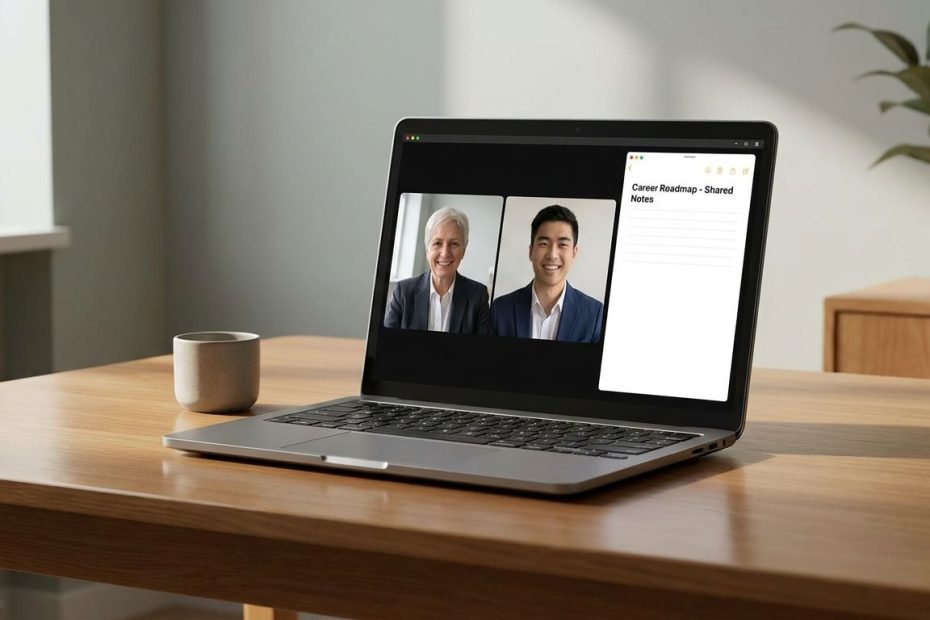
Video works best for relationship-building, difficult feedback, career strategy, and moments where tone matters. Messaging works best for quick check-ins, sharing articles, asking narrow questions, or keeping momentum between meetings. Shared documents work best for goals, notes, decisions, and accountability. When you combine those three pieces, you create a durable rhythm that survives busy calendars.
Email still works well for formal outreach, longer reflection, and scheduling. Team collaboration tools like Microsoft Teams or Slack can work well when the relationship sits inside an organization and communication already lives there. If your company operates in one ecosystem, use that ecosystem unless there is a strong reason not to. Familiarity lowers resistance and makes the relationship easier to maintain.
You should resist the urge to overbuild. Do not create five channels for one mentoring relationship. One video platform, one messaging channel, and one shared document are usually enough. Every extra tool adds one more point of failure. Simplicity matters more than novelty.
If you run mentorship at the team or company level, your tooling decision should support scale, visibility, and consistency. You need a home for resources, program guidance, scheduling norms, and shared learning. Peer champion models inside collaboration tools can help people support one another and normalize digital help-seeking. Still, the tool does not create trust by itself. You need clear norms for response times, meeting prep, documentation, and respectful communication.
If you are choosing between tools, ask three practical questions. Can both people use it easily? Does it support the type of conversation you need most often? Will it reduce coordination effort rather than create more? Those answers usually lead you to the right setup faster than any feature comparison chart.
How Do You Build Trust And Real Human Connection Through A Screen?
You build trust in digital mentorship through consistency, clarity, responsiveness, and follow-through. People often assume connection comes from personality alone. In remote relationships, trust is built more visibly through behavior. You show up when you said you would, you respond within the agreed window, you listen carefully, and you remember what mattered last time.
One of the biggest mistakes in digital mentoring is relying on vague warmth. Being friendly helps, but it is not enough. A mentee trusts you when your feedback is specific, your expectations are clear, and your actions match your words. A mentor trusts a mentee when preparation is visible, action follows advice, and communication stays honest rather than performative.
Start meetings with a short personal check-in, then move into substance. Keep that check-in real and proportionate. You are not trying to force emotional disclosure. You are creating enough room for context so the conversation reflects reality rather than a polished status update. That distinction matters because career decisions are shaped by stress, confidence, workload, and uncertainty, not just goals on paper.
Text communication needs extra care. Messages can sound sharper, colder, or more casual than intended. If you are giving feedback in writing, make your meaning explicit. If you receive a message that feels off, ask for clarification before interpreting intent. Strong digital mentors do not let misunderstanding sit and harden.
You also deepen trust by closing loops. If you promised a resource, send it. If you agreed to review something, review it. If you asked the mentee to update you, acknowledge the update. Reliability is one of the most underrated forms of care in mentorship. In digital settings, it becomes one of the strongest trust signals you can offer.
If you are the mentor, protect your own capacity too. Presence matters, and burnout weakens presence fast. It is better to set a sustainable pace than to overcommit and vanish. A mentor who is clear about availability is more trustworthy than one who sounds generous and disappears when work gets busy.
What Does Good Mentoring Look Like From The Mentee Side?
If you are being mentored, your job is not to absorb advice. Your job is to convert guidance into action, reflection, and better judgment. Too many mentees wait for a mentor to drive the relationship. That creates a passive dynamic and drains energy from both sides. In most successful mentoring relationships, the mentee owns the logistics, the questions, and the follow-through.
Come prepared with decisions you need help making, patterns you want to understand, or situations you need to handle better. Generic prompts get generic answers. Specific questions produce useful guidance. Instead of asking, “How do I grow my career?” ask, “Which skill gap is holding me back from moving into management?” or “How should I handle a manager who gives vague feedback?”
You should also report back on what happened after previous conversations. Did you test the suggestion? Did it work? What changed? This is how mentorship compounds. The mentor learns how you operate, and you build a record of decisions and outcomes. Over time, the relationship shifts from advice-giving to sharper pattern recognition.
Respect the boundaries of the relationship. A mentor is not your on-demand problem-solving service, emotional dumping ground, or replacement for professional support in areas outside mentorship. Keep the relationship goal-oriented, practical, and honest. If you need help beyond the scope of mentoring, name that clearly and seek the right resource.
You should also make it easy to help you. Share documents in advance when feedback is needed. Summarize your situation cleanly. Ask direct questions. Close with clear next steps. Mentors stay engaged when they can see movement. Stagnation, vagueness, and repeated inaction make even generous mentors pull back.
One more point matters in digital mentorship: gratitude should be visible, but not performative. Thank the mentor, update them on impact, and show that their time changed something. People stay invested when they see evidence that the relationship matters.
What Does Good Mentoring Look Like From The Mentor Side?
If you are the mentor, your role is to accelerate the other person’s judgment, confidence, and effectiveness. You are not there to produce dependency or to hand over a script for every decision. Strong mentors help mentees think better, not just act faster. That means you listen for patterns, ask sharper questions, and guide the person toward clearer reasoning.
You serve the relationship best when you define expectations early. Clarify what kind of help you can offer, how often you can meet, what communication channel you prefer, and what falls outside your role. This protects the relationship from resentment and confusion. It also creates a healthier environment for honest conversation.
Good mentors do not dominate the meeting. They create room for the mentee to think aloud, test assumptions, and expose uncertainty without feeling judged. If you answer every question too quickly, you train dependence. If you ask disciplined questions and then offer grounded advice, you build independence.
Your feedback should be candid and usable. Avoid vague encouragement when the mentee needs correction. Name the issue, explain why it matters, and suggest a stronger move. You can deliver hard feedback with respect. In fact, many mentees value mentors most when they get truth they are not hearing elsewhere.
You should also know when to redirect. If the mentee brings issues that belong in management, therapy, legal support, or human resources, you need to say so plainly. Mentorship works best when its purpose is intact. Once the relationship starts carrying every type of problem, quality drops and boundaries blur.
One of the strongest things you can do as a mentor is model professional behavior in digital form. Be on time. Be prepared. Be direct. Keep notes. Follow through. Those behaviors teach as much as your actual advice, because the mentee sees what disciplined professional conduct looks like under modern working conditions.
How Do You Set Boundaries, Safety, And Communication Norms In Digital Mentorship?
Digital mentorship needs explicit boundaries because online communication tends to erase natural limits. If you do not define where communication happens, how fast responses should come, and what kinds of issues belong in the relationship, you create silent mismatches. Those mismatches often show up later as frustration, guilt, or withdrawal.
Start with simple agreements. Decide which channel is for scheduling, which is for quick questions, and which is for deeper conversations. Set a normal response window. Clarify how to reschedule. Decide whether direct messages are fine or whether communication should stay inside a workplace platform or email. These rules are not cold. They make the relationship safer and easier to maintain.
Confidentiality should also be addressed. If a mentee shares sensitive career concerns, both people need a clear understanding of what stays private and what may need to be escalated. This matters in workplaces, educational settings, and industry communities. Trust grows when expectations are spoken rather than assumed.
Time zones and digital overload need active management. If the relationship crosses regions, alternate meeting times fairly rather than locking inconvenience onto one person. Keep messages concise. Batch non-urgent updates. Protect each other from the false urgency that chat tools create. Good mentorship supports growth, not constant access.
You should also recognize the line between support and emotional overreach. Mentoring includes encouragement, reality checks, and thoughtful listening. It should not become unbounded emotional processing. When the conversation drifts too far from career development and decision support, it is your job to reset the scope respectfully.
If you are running a formal mentoring program, boundaries need to be built into design, not left to chance. Screening, training, matching, monitoring, and closure all matter. Informal mentoring can rely more on individual maturity. Programmatic mentoring needs operating standards that protect participants and keep quality consistent.
Does Virtual Mentoring Actually Work?
Yes, virtual mentoring can work very well when it is structured well, matched well, and maintained well. The strongest evidence does not suggest that digital automatically beats in-person mentoring or falls short of it. The real performance difference comes from execution. Relationships with clear goals, reliable communication, and strong follow-through produce results across settings.
Research across education and mentoring practice points to gains in confidence, persistence, and self-efficacy when virtual mentoring is designed with support, monitoring, and intentional interaction. That matters because many people still assume remote mentoring is inherently weaker. It is not weaker by default. It is less forgiving of sloppy design.
You can also see this in everyday professional life. A remote mentee with clear goals, regular check-ins, and a mentor who gives direct feedback often advances faster than an in-office employee with vague support and inconsistent attention. Digital access expands the talent pool too. You can connect with mentors outside your employer, geography, and immediate network, which often improves fit.
The catch is simple: digital mentoring exposes weak habits fast. If neither person prepares, if meetings drift, if communication norms are fuzzy, or if trust is neglected, the relationship fades. People then blame the format when the real problem was poor execution. Virtual mentoring works when you build it with intent and run it with discipline.
How Do You Mentor And Be Mentored Online Effectively?
- Set one clear goal for the relationship.
- Use video for depth, messaging for quick follow-up, shared docs for notes.
- Meet on a steady cadence and send an agenda before each call.
- Define boundaries, response times, and next steps after every meeting.
Build A Mentoring Relationship That Actually Moves Your Career Forward
Digital mentorship gives you access that previous generations had to wait years to build, but access alone does not create growth. You need clear goals, a workable rhythm, the right tools, and communication habits that hold up when work gets busy. If you are the mentee, own the process and turn advice into action. If you are the mentor, guide with clarity, boundaries, and candor that helps the other person think better. When you treat mentorship as a disciplined relationship rather than an occasional chat, you create something that delivers real career value over time.
References:
- https://nationalmentoringresourcecenter.org/resource/e-mentoring/
- https://www.northwestern.edu/provost/faculty-resources/mentoring-excellence/principles.html
- https://link.springer.com/article/10.1186/s12909-024-05852-x
- https://learn.microsoft.com/en-us/microsoftteams/teams-adoption-create-champions-program
- https://journals.sagepub.com/doi/full/10.1089/heq.2021.0060
- https://www.norc.org/research/projects/college-mentoring-programs-evaluation.html
- https://www.mentoring.org/blog/research/elements-leads-effective-practice/
- https://www.reddit.com/r/consulting/comments/1oo42pg/how_to_find_a_mentor/
- https://www.reddit.com/r/Slack/comments/1axn8a6
- https://www.reddit.com/r/careerguidance/comments/1idsn76

Olivier Gillier is a global investment strategist and co-founder of RioBlanco Capital LLC, with over 20 years of experience in wealth management and international markets. A former Senior Vice President at Merrill Lynch, he now focuses on private equity, cross-border finance, and philanthropic initiatives worldwide.